Most RV owners plug in at home at some point, whether it's to keep the batteries charged, run the fridge before a trip or let the kids camp out in the driveway. But home power and RV power don't always match, and that's where problems start: tripped breakers, warm cords, melted plugs and sometimes damaged electronics inside the RV.
Here's what you need to know about 30 amp and 50 amp RV power and how to plug in at home safely.
What 30 amp and 50 amp actually mean
30 amp service uses a three-prong plug and provides 120 volts. It's common on travel trailers and smaller motorhomes. It can typically run one A/C unit and a few other appliances, but not everything at once.
50 amp service uses a four-prong plug and provides two 120-volt lines. It's common on larger motorhomes and fifth wheels with two A/C units and more appliances. It provides much more total power than 30 amp.
You can tell which you have by looking at your RV's power cord plug.
Can you plug an RV into a regular house outlet?
Yes, with an adapter, but with limits. A standard household outlet is usually on a 15 or 20 amp circuit. That's enough to charge batteries and run small loads like lights, the fridge on electric and maybe a small appliance. It's usually not enough to run the A/C, the microwave and a hair dryer at the same time.
If you try, the breaker will likely trip. And if the cord or adapter is undersized or damaged, it can overheat.
About adapters
Adapters (sometimes called dogbones) let you connect a 30 or 50 amp RV cord to a different outlet. They're useful, but they don't create more power. An adapter only changes the shape of the plug. If you plug a 50 amp RV into a 15 amp household outlet, you get 15 amps.
Use adapters that are rated for the job, in good condition, and not hot to the touch while in use.
Never use the dryer outlet
Some people try to plug their RV into a dryer outlet with an adapter. This is a bad idea. Many dryer outlets provide 240 volts in a way that can send too much voltage to a 30 amp RV and damage appliances and electronics. If you want an RV outlet at home, have a licensed electrician install the correct RV outlet.
Use a surge protector
A surge protector or electrical management system plugged in between the outlet and your RV cord can protect your RV from voltage spikes, low voltage and miswired outlets. Some models also show you voltage so you can spot a problem before it causes damage. This is worth having at home and at campgrounds.
Signs something is wrong
| What you notice | What it may mean |
|---|---|
| Breaker trips at home | Too much load for the circuit |
| Cord or plug feels warm or hot | Overload or bad connection |
| Plug or outlet looks melted or discolored | Overheating, stop using it |
| Lights dim when the A/C starts | Low voltage |
| Some outlets dead in the RV | Tripped GFCI or breaker, or a loose connection |
If you see melted or burned plastic, unplug and stop using that cord, outlet or adapter until it's checked.
Simple rules for plugging in at home
- 1Know your RV's service: 30 or 50 amp.
- 2Use a properly rated adapter in good condition.
- 3Keep the load low on a household outlet: no A/C plus microwave plus everything else.
- 4Use a surge protector.
- 5Never use a dryer outlet.
- 6Use the shortest, heaviest extension cord you can if you need one; avoid long, thin household extension cords.
- 7Check the cord and plug for heat after it's been running a while.
When to call for help
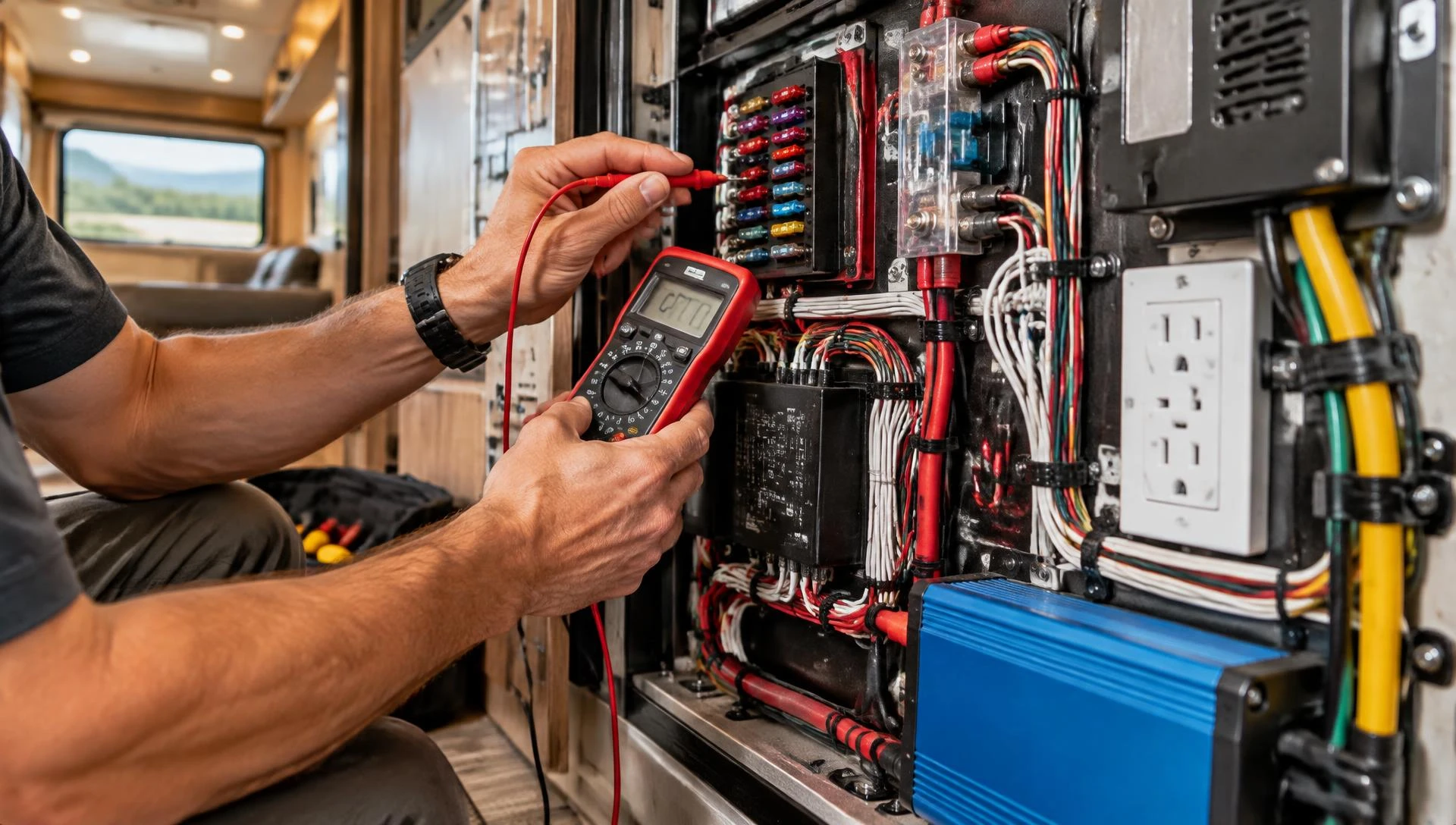
If you have outlets that don't work, lights that flicker, a converter that doesn't seem to charge, or any burned or melted plugs, it's time to have the electrical system checked. Frederick works on both the 12-volt and 110-volt sides of RVs and can track down where the problem is, from the shore power cord to the outlets. You get the diagnosis and the price before any work, at $85 an hour with parts billed at cost.
Electrical problem in your RV? Call Frederick at (405) 429-9795 or send a request.
Questions
Quick answers
Sometimes on a 20 amp circuit with nothing else running, but it often trips the breaker or runs on low voltage. A properly installed RV outlet is better.
Related services